Automotive styling distributors, premium car tuning shop managers, and lightweight component procurement officers must carefully evaluate raw polymer material data before finalizing manufacturing orders. Because high-performance composite shells face intense sun exposure and mechanical stress on the road, selecting a highly stable carbon fiber accessories resin matrix is essential to ensure long-term structural integrity. Consequently, commercial purchasing agents frequently scrutinize chemical specifications with technical skepticism, raising a highly practical question: “Does the choice of polymer chemical backing genuinely alter the field survival of a woven exterior spoiler or mirror cap?</i> Furthermore, should our acquisition team specify a high-strength epoxy resin matrix or choose a weather-resistant acrylic resin formula to protect our fleet investments?”
Sourcing an incorrect polymer matrix system can lead to rapid product failure, severe surface yellowing, and expensive customer warranty claims within a few months of use. Selecting a weak adhesive system causes the clear coat layers to crack, allowing water to seep in and delaminate the woven fabric beneath. This comprehensive B2B engineering guide quantifies the mechanical differences between epoxy and acrylic bindings, outlines specific application scenarios, and provides a clear strategic purchasing framework for your inventory.
1. Quantifying the Mechanical and Chemical Differences: Tensile Strength vs. Weather Resistance
To optimize the service lifespan of custom exterior body kits, your engineering team must analyze how different polymer matrix systems react to physical loads and environmental stress. A polymer matrix serves as the binding agent that locks individual carbon fibers in place, distributing incoming forces evenly across the entire composite structure.
Evaluating the mechanical properties of an epoxy-bound carbon fiber reinforced polymer (CFRP) reveals superior raw strength in its pristine, factory-new state. Epoxy formulations provide excellent surface adhesion and cross-linking density, delivering approximately 15% higher tensile strength and a 20% advantage in flexural modulus compared to acrylic alternatives. This extreme rigidity makes epoxy the classic choice for structural racing applications where pure weight reduction and absolute stiffness dictate performance.
However, executing long-term weather testing reveals a significant performance drop for standard epoxy materials. When an epoxy matrix faces continuous outdoor sunlight, ultraviolet (UV) radiation breaks down its molecular bonds, causing the plastic to yellow, lose its gloss, and experience micro-cracking. This solar degradation can reduce the total mechanical strength of an epoxy composite by up to 16% over time.
In contrast, advanced acrylic matrix systems utilize highly stable polymer chains that resist solar radiation naturally. An acrylic binding system prevents yellowing and resists structural cracking under severe weather exposure, allowing your premium exterior components to retain their structural integrity and glossy show-car appearance across years of daily driving.
2. Strategic Scenario Recommendations: Matching Polymer Matrices to Real-World Driving Conditions
Procurement teams can easily maximize their return on investment by choosing their core composite chemistry based on the specific driving environment of the vehicle.
Show Cars and Lower Outdoor Exposure Environments (Epoxy Selection)
If your distribution network primarily targets climate-controlled indoor show cars, track-only racing vehicles, or fair-weather weekend sports cars, specifying a high-strength epoxy matrix is the most logical choice. This chemical selection provides the highest possible structural rigidity and impact resistance out of the box, allowing thin aerodynamic diffusers and splitter lips to withstand high downward wind forces without warping or bending.
Daily Driving and High-Frequency Outdoor Exposure (Acrylic Selection)
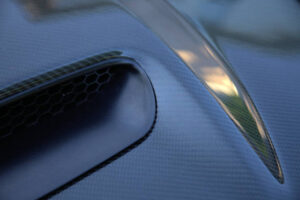
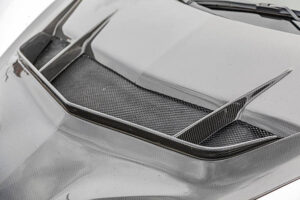
When sourcing consumer accessories like exterior rearview mirror housings, raised trunk spoilers, hood vents, and rooftop cargo covers, the components must survive continuous exposure to rain, snow, and hot summer sun. For these daily-driven scenarios, selecting an acrylic matrix system is the most reliable strategy. Choosing acrylic ensures the product maintains its deep 3D woven aesthetic, retains its impact strength, and completely avoids costly UV yellowing complaints, saving your brand from expensive post-sale replacements.
3. The Sourcing Checklist: Critical Checkpoints for Corporate Buyers
Sourcing managers can protect their inventory investments by incorporating three technical verification steps into their international vendor evaluation processes:
-
Insist on Accelerated Xenon-Arc Weathering Logs: Do not accept vague marketing phrases like “UV protected” from a supplier. Always require official laboratory test sheets documenting that the material has undergone 1,000+ hours of accelerated weathering under ASTM G155 standards to prove its true yellowing resistance.
-
Audit the Clear Coat Compatibility: Verify that the factory applies a premium, automotive-grade polyurethane clear coat that bonds perfectly with the underlying acrylic or epoxy matrix layer, creating a thick barrier against scratches and stone chips.
-
Confirm the Curing Temperature Profiles: Ensure the manufacturing facility utilizes professional autoclave or vacuum-infusion baking processes rather than cheap room-temperature curing methods, maximizing the heat distortion temperature (HDT) of the resin so the body kits will not warp during hot summer days.
Conclusion: Choose the Right Carbon Fiber Material for Long-Term Performance
Selecting the right carbon fiber material plays an important role in automotive component performance and product quality. High-quality carbon fiber accessories provide better durability, dimensional stability, and long-term appearance in demanding outdoor environments.
In addition, reliable resin systems help reduce the risk of discoloration, cracking, and delamination during long-term use. Therefore, manufacturers and distributors can improve product reliability and customer satisfaction while reducing after-sales issues.
Whether you supply aftermarket upgrades, performance vehicles, or OEM automotive projects, choosing a trusted carbon fiber component manufacturer supports consistent product quality and stable production. Contact our team to learn more about our custom carbon fiber accessories, material options, and manufacturing capabilities for your next automotive project.


Leave a reply