Understanding the Carbon Fiber Layup Process
The carbon fiber layup process is a critical step in manufacturing high-performance composite materials. Carbon fiber composites are widely used because they offer excellent strength while keeping weight low.
At its core, carbon fiber layup involves arranging multiple layers of carbon fiber fabric. These layers are then impregnated with resin and cured to form a solid composite structure.
Each layer, also called a ply, contributes to the mechanical performance of the final component. Therefore, precise fiber placement and professional processing are essential for achieving consistent results.
Why Is Carbon Fiber Layup Important?
The layup configuration directly affects the strength, stiffness, durability, and environmental resistance of a carbon fiber panel.
More importantly, the fiber orientation determines how the composite responds to different loads. For example, unidirectional carbon fiber layers can provide high tensile strength along a specific direction.
In contrast, woven fabrics can provide a better balance of toughness and impact resistance.
Therefore, engineers must select the appropriate layup structure according to the expected loads and application requirements.
The Role of Resin in Carbon Fiber Layup
Besides fiber arrangement, resin selection is equally important in the carbon fiber layup process.
The resin acts as the bonding matrix that holds the carbon fibers together. Its viscosity, curing temperature, and curing time can directly influence the final composite properties.
Proper curing is especially important. If the resin does not cure consistently, the finished carbon fiber panel may develop internal weaknesses or other defects.
For this reason, manufacturers must carefully control resin application and curing conditions throughout production.
Vacuum Bagging for Better Composite Quality
In addition, vacuum bagging is commonly used during carbon fiber layup. This technique helps remove trapped air and excess resin from the laminate.
As a result, the finished composite can achieve a more consistent fiber-to-resin ratio and improved density.
Furthermore, controlled pressure during curing improves the bonding between individual layers. This interlaminar bonding is essential for the durability and service life of carbon fiber components.
Therefore, understanding these fundamental carbon fiber layup principles provides a strong foundation for optimizing more advanced composite designs.
The Role of Fiber Orientation in Carbon Fiber Panel Performance
The orientation of each carbon fiber layer plays a major role in determining the structural performance of a composite panel.
In particular, the correct layup configuration helps control how stress is distributed throughout the component. This is especially important for high-stress applications, including automotive structural and aerodynamic components.
Because carbon fiber has an excellent strength-to-weight ratio, it is widely used in demanding industrial applications.
However, carbon fiber is not equally strong in every direction. Therefore, engineers must carefully control fiber orientation during the carbon fiber layup process.
Common Carbon Fiber Layer Orientations
Carbon fiber layers are commonly arranged at different angles, including:
- 0° orientation
- 90° orientation
- +45° orientation
- −45° orientation
Each orientation provides different mechanical characteristics.
For example, 0° fibers primarily improve strength and stiffness along their longitudinal direction. Meanwhile, ±45° layers are particularly useful for managing shear loads.
As a result, combining different fiber orientations allows engineers to create a customized mechanical response.
Unidirectional Carbon Fiber Layup
A unidirectional carbon fiber layup places most fibers in the same direction.
This configuration provides excellent tensile strength and stiffness along the primary loading axis. Therefore, it works particularly well for components that experience predominantly one-directional loads.
Cross-Ply Carbon Fiber Layup
By comparison, a cross-ply layup combines layers at different angles.
This configuration distributes loads more evenly across the composite. Consequently, it can improve overall toughness and reduce the risk of localized structural failure.
This approach is particularly valuable for automotive components that experience complex combinations of tensile, compressive, and shear forces.
Ultimately, the correct carbon fiber fabric orientation should be determined by analyzing the expected loads and performance requirements.
Case Study: Carbon Fiber Layup for an Automotive Rear Spoiler
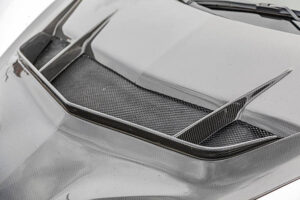
Carbon fiber panels are increasingly used in automotive applications because they can reduce weight while maintaining high structural performance.
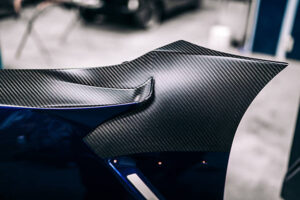
A carbon fiber rear spoiler is a good example of how careful layup design can improve both structural and aerodynamic performance.
Typical Carbon Fiber Spoiler Layup
A typical carbon fiber rear spoiler may use approximately 8 to 12 layers of carbon fiber fabric.
Each layer contributes to the overall stiffness and structural integrity of the spoiler. At the same time, engineers must carefully control the total laminate thickness to avoid unnecessary weight.
Therefore, the final design requires careful selection of:
- Carbon fiber fabric type
- Resin system
- Number of layers
- Fiber orientation
- Layer sequence
- Curing conditions
Managing Aerodynamic Loads
Fiber orientation is particularly important for a carbon fiber rear spoiler.
At high speeds, aerodynamic forces place significant loads on the spoiler. Therefore, engineers can change the orientation of individual layers to increase strength along specific load paths.
For example, strategically placed ±45° layers can help manage shear forces. Meanwhile, 0° layers can provide greater stiffness along the primary structural direction.
As a result, the layup sequence directly affects the spoiler’s ability to maintain its shape under aerodynamic loads.
Environmental Conditions During Curing
Environmental conditions also require careful consideration.
Temperature and humidity can influence resin flow and curing behavior. Therefore, manufacturers should maintain controlled processing conditions during the carbon fiber layup and curing stages.
When properly engineered, a carbon fiber rear spoiler can combine:
- Lower component weight
- High structural stiffness
- Improved aerodynamic performance
- Premium visual appearance
Thus, this application demonstrates how precise carbon fiber layup design can support both performance and aesthetic objectives.
Choosing the Right Carbon Fiber Fabric: Unidirectional vs. Twill Weave
Selecting the correct carbon fiber fabric is another important decision in composite manufacturing.
Two commonly used options are unidirectional carbon fiber and twill weave carbon fiber. However, their structures and performance characteristics differ significantly.
Therefore, engineers should select the fabric according to the application’s mechanical and aesthetic requirements.
Unidirectional Carbon Fiber
Unidirectional carbon fiber contains fibers aligned primarily in one direction.
As a result, it provides excellent tensile strength and stiffness along that specific axis.
This makes unidirectional fabric particularly suitable for applications that require a high strength-to-weight ratio.
Typical applications include:
- Aerospace components
- High-performance automotive parts
- Structural reinforcement
- Load-bearing composite components
Moreover, the aligned fibers allow efficient load transfer along the primary load direction.
Therefore, engineers can use unidirectional carbon fiber to achieve more precise control over the mechanical properties of the final composite.
Twill Weave Carbon Fiber
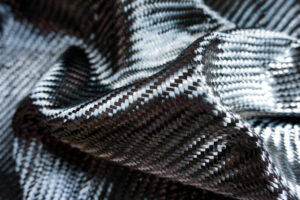
In contrast, twill weave carbon fiber uses an interwoven fiber structure.
This construction provides a useful balance between strength, flexibility, and conformability.
More importantly, twill weave fabric offers excellent drape characteristics. Therefore, it is easier to form around complex curves and surfaces.
Twill weave carbon fiber also provides a distinctive woven appearance. For this reason, it is widely selected for visible automotive components where aesthetics are important.
In addition, its woven structure can help distribute loads across multiple directions. Consequently, it may provide useful impact resistance for certain applications.
Unidirectional vs. Twill Weave Carbon Fiber: Which Should You Choose?
For technical buyers and engineers, the choice should depend on the intended application rather than appearance alone.
| Factor | Unidirectional Carbon Fiber | Twill Weave Carbon Fiber |
|---|---|---|
| Fiber Direction | Primarily one direction | Multiple interwoven directions |
| Main Advantage | High directional strength | Balanced strength and flexibility |
| Stiffness | Excellent along fiber direction | More balanced across directions |
| Load Transfer | Highly efficient along primary axis | More evenly distributed |
| Formability | More limited | Excellent drape and conformability |
| Appearance | Directional fiber pattern | Distinctive woven pattern |
| Typical Use | Structural components | Complex and visible components |
| Key Selection Factor | Mechanical performance | Performance and aesthetics |
Therefore, unidirectional carbon fiber is generally more suitable when maximum directional strength is the priority.
Meanwhile, twill weave carbon fiber is often preferable when the component requires complex shaping, balanced performance, and a premium visual finish.
How to Optimize Carbon Fiber Layup Design
Ultimately, selecting the right fabric is only one part of successful composite manufacturing.
Engineers should also consider the complete carbon fiber layup design, including:
- Expected Load Direction
Identify where tensile, compressive, and shear forces will act. - Fiber Orientation
Select 0°, 90°, and ±45° layers according to the load requirements. - Layer Sequence
Optimize the stacking sequence to achieve balanced structural performance. - Fabric Selection
Choose between unidirectional and woven carbon fiber according to the application. - Resin System
Match resin properties with the required curing process and operating environment. - Curing Method
Select an appropriate curing process to achieve consistent laminate quality. - Final Component Requirements
Consider weight, stiffness, strength, appearance, durability, and production cost.
By evaluating these factors together, manufacturers can develop carbon fiber panels that deliver the required combination of strength, stiffness, weight reduction, and durability.
Technical Summary
The carbon fiber layup process determines how carbon fiber layers work together to achieve the required mechanical performance.
In particular, fiber orientation, fabric selection, resin properties, layer sequence, and curing conditions all influence the final composite structure.
For applications requiring high directional strength, unidirectional carbon fiber offers excellent stiffness and tensile performance.
By contrast, twill weave carbon fiber provides better drape, balanced performance, and an attractive woven appearance.
For automotive applications such as carbon fiber rear spoilers, a carefully engineered layup can also help manage aerodynamic loads while reducing component weight.
Therefore, successful carbon fiber manufacturing requires more than simply selecting a lightweight material. Instead, engineers must optimize the complete layup architecture according to the component’s load conditions, structural requirements, manufacturing process, and aesthetic objectives.




Leave a reply