
In the world of high-performance automotive tuning, true performance gains come not only from adding horsepower but also from removing unnecessary weight. Experienced racers often follow a simple principle: more power improves straight-line speed, while less weight improves performance everywhere. Therefore, although engine upgrades frequently dominate discussions, professional drivers and automotive engineers consistently recognize weight reduction as one of the most effective ways to enhance acceleration, cornering, braking, and overall vehicle dynamics.
As modern performance vehicles become more advanced, lightweight engineering plays an increasingly important role in achieving faster lap times and sharper road response. Among the most impactful upgrades available today, a full carbon fiber body kit stands out as both a visual enhancement and a functional performance solution. Rather than serving purely aesthetic purposes, advanced carbon fiber components actively reduce vehicle mass while maintaining exceptional structural rigidity and aerodynamic efficiency.
By replacing traditional steel and aluminum panels with high-strength composite materials, drivers can improve the power-to-weight ratio, reduce chassis load, and create a more responsive driving experience. Moreover, lighter body structures allow suspension systems and braking components to operate more efficiently under demanding conditions. As a result, the vehicle delivers better handling precision, faster directional changes, and improved stability at high speeds.
In this guide, we will explore the measurable performance advantages of carbon fiber body kits and examine how advanced composite engineering transforms modern automotive tuning. From acceleration gains to handling improvements, we provide the quantitative insights needed to understand why lightweight performance upgrades continue to define the future of high-performance driving.
The Quantitative Impact: Component-by-Component Data
Switching to carbon fiber offers a dramatic reduction in mass compared to factory-installed metal panels. Because carbon fiber has a much higher strength-to-weight ratio, we can achieve structural integrity with significantly less material.
-
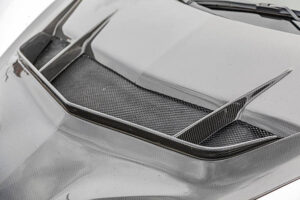
Carbon Fiber Hood (Bonnet): A standard steel hood can weigh upwards of 18-25kg. A high-quality carbon fiber replacement typically achieves a 60% weight reduction, dropping the weight to approximately 7-9kg.
-
Carbon Fiber Doors: Factory doors are often the heaviest panels due to internal reinforcements. Swapping to carbon fiber can result in a 50% weight saving, significantly lowering the vehicle’s side-impact mass and improving lateral agility.
-
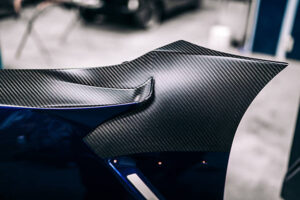
Carbon Fiber Trunk Lid: This is often where the most dramatic gains are found. A carbon fiber trunk can offer up to a 70% weight reduction compared to the original assembly, especially when replacing heavy hydraulic or spring-assisted steel lids.
Consequently, by replacing these three major areas, you are removing “dead weight” from the highest and furthest points of the car, which directly improves the center of gravity.
From Kilograms to Seconds: Track Performance Gains
Weight reduction is not just a number on a scale; it translates directly into physics on the racetrack. For most mid-sized performance cars, a full carbon fiber body kit—including the hood, trunk, doors, and fenders—results in a total cumulative weight loss of 80kg to 120kg.
-
The 1-2 Second Advantage: In professional racing, a 100kg weight reduction typically equates to a 1 to 2-second improvement in lap times on a standard 3-minute circuit.
-
Braking and Acceleration: With 100kg less mass to move, your braking distances are shortened, and your power-to-weight ratio increases without ever touching the engine.
-
Reduced Component Wear: Lighter cars put less stress on tires, brake pads, and suspension bushings.
Consequently, carbon fiber parts pay for themselves through reduced maintenance and increased competitive edge. Therefore, it remains the most direct means of performance modification available today.
Weight Savings Comparison Table
| Component | Standard Steel Weight | Saibang Carbon Fiber Weight | % Weight Saved |
| Hood / Bonnet | ~20 kg | ~8 kg | 60% |
| Front Doors (Pair) | ~40 kg | ~20 kg | 50% |
| Trunk Lid | ~15 kg | ~4.5 kg | 70% |
| Full Body Kit Total | ~180 kg+ | ~75 kg | Avg. 58% |
Conclusion: The Ultimate Performance Investment
Stop trying to “overpower” a heavy chassis with expensive engine tunes that increase heat and decrease reliability. Instead, embrace the lightweight revolution with professional-grade performance carbon fiber parts. Consequently, your car will feel more responsive, stop faster, and corner with a level of precision that metal panels simply cannot provide. Experience the raw physics of carbon fiber today. Your lap times will thank you.




Leave a reply