For performance-focused vehicle owners, racing teams, and automotive modification businesses, lightweight carbon fiber parts offer an effective way to reduce vehicle mass while creating a distinctive appearance. Components such as carbon fiber hoods, フェンダー, rear wings, and interior panels can replace heavier conventional materials. しかし, reducing weight is only one part of a successful upgrade. Buyers must also evaluate structural rigidity, 耐衝撃性, mounting strength, fitment accuracy, そして長期的な耐久性. A component that looks lightweight but lacks suitable engineering may not withstand repeated vibration, aerodynamic loads, or demanding track conditions.
This guide explains how automotive weight reduction affects vehicle performance, which carbon fiber components offer practical upgrade opportunities, and how buyers can balance weight savings with structural requirements. It also provides a purchasing framework for racing teams, performance tuning shops, and automotive aftermarket brands.
1. The Physics of Performance: How Weight Reduction Boosts Speed and Handling
Reducing vehicle weight can improve several aspects of vehicle performance. しかし, the benefits depend on where the weight is removed, how much mass is reduced, and how the vehicle is configured.
Carbon fiber composites are attractive because they can provide high stiffness and strength relative to their weight when designed and manufactured appropriately.
1.1 How Lower Vehicle Mass Affects Acceleration
A vehicle requires force to accelerate its mass. Under otherwise comparable conditions, reducing mass can improve acceleration response because the powertrain needs to move less weight.
The basic relationship is:
[ F = ma ]
Where:
- (F) represents the applied force.
- (m) represents vehicle mass.
- (ある) represents acceleration.
For a vehicle with the same available driving force, reducing mass can increase acceleration.
しかし, real-world acceleration also depends on engine or motor output, gearing, traction, aerodynamic drag, tire grip, and power delivery. A carbon fiber hood alone will not transform a vehicle’s acceleration if the total weight reduction is small relative to its overall mass.
For performance buyers, the more useful question is how much weight the complete upgrade package removes and whether the reduction supports the vehicle’s intended use.
1.2 Why Unsprung Mass Matters for Handling
Unsprung mass refers to the vehicle components that are not supported by the suspension springs. Typical examples include wheels, tires, brake assemblies, and certain suspension components.
Reducing unsprung mass can help the suspension respond more effectively to road irregularities. It may improve tire contact consistency, particularly over uneven surfaces and during rapid suspension movements.
しかし, not every carbon fiber body component reduces unsprung mass.
| 成分 | Typical Mass Category | Potential Performance Effect |
|---|---|---|
| Carbon fiber hood | Sprung mass | Reduces overall vehicle mass and may lower front-end weight |
| Carbon fiber fender | Sprung mass | Reduces body-panel mass |
| Carbon fiber rear wing | Sprung mass | May reduce component mass while maintaining aerodynamic function |
| Carbon fiber interior trim | Sprung mass | Reduces cabin component mass |
| Carbon fiber wheel | Unsprung mass | Can reduce rotating and unsprung mass if properly engineered |
| Carbon fiber suspension component | Depends on design and mounting | Requires specialized structural and fatigue validation |
このため, buyers should distinguish between general vehicle weight reduction and unsprung mass reduction when evaluating upgrade claims.
1.3 Effects on Braking and Cornering
Lower vehicle mass can reduce the kinetic energy that the braking system must dissipate at a given speed.
Kinetic energy is calculated as:
[ E_k = \frac{1}{2}mv^2 ]
Where:
- (E_k) is kinetic energy.
- (m) is vehicle mass.
- (v) is vehicle speed.
At the same speed, a lighter vehicle has less kinetic energy. This can reduce braking energy requirements, although actual stopping distance also depends on tire grip, brake performance, road conditions, brake temperature, and vehicle dynamics.
Weight reduction can also improve cornering response by reducing the forces associated with vehicle mass. Its impact depends on weight distribution, center of gravity, suspension setup, tire performance, and aerodynamic balance.
A well-planned lightweight upgrade should therefore consider the entire vehicle rather than focusing on a single component.
1.4 Power-to-Weight Ratio: A Useful Buying Metric
The power-to-weight ratio compares available engine or motor power with vehicle mass.
[ \text{Power-to-weight ratio} = \frac{\text{Engine power}}{\text{Vehicle mass}} ]
A higher ratio generally indicates greater power relative to vehicle weight.
例えば, if a vehicle produces 300 hp and weighs 1,500 kg, its power-to-weight ratio is 0.20 hp/kg.
If a verified upgrade package reduces the vehicle mass to 1,450 kg without changing power, the ratio becomes approximately 0.207 hp/kg.
This illustrates how weight reduction can improve the ratio without increasing engine output.
しかし, buyers should use actual measured component weights rather than estimated marketing figures when calculating the potential benefit.
2. Essential Lightweight Upgrades: フード, フェンダー, Wings, and Interior Components
Not every carbon fiber component delivers the same performance benefit. The best upgrade depends on the vehicle platform, intended application, インストール要件, and budget.
For aftermarket brands and tuning shops, choosing components with clear functional value can also improve product positioning.
2.1 Carbon Fiber Hoods: A Practical Starting Point
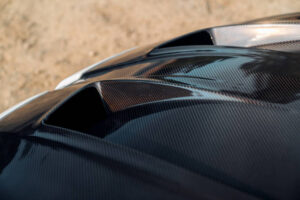
A carbon fiber hood is one of the most recognizable automotive lightweight upgrades.
Compared with a conventional steel hood, a properly designed carbon fiber hood may reduce front-end body mass. This can support overall vehicle weight reduction and offer a distinctive exterior finish.
Important purchasing considerations include:
- Total component weight
- Outer skin and inner reinforcement design
- Hinge and latch compatibility
- Mounting-point strength
- Hood clearance and engine-bay fitment
- Heat resistance near the engine
- Water management and sealing
- Surface finish and UV protection
A lightweight hood must still provide suitable rigidity and secure retention. Buyers should confirm whether the original latch system can be retained and whether additional hardware is required.
For road-going vehicles, hood retention and pedestrian-safety requirements may also apply. A track-only product should not automatically be assumed suitable for public-road use.
2.2 Carbon Fiber Fenders: Weight Reduction and Exterior Styling
Carbon fiber fenders can replace selected original body panels and help create a more aggressive vehicle appearance.
They are commonly used in sports car customization, widebody conversions, and performance-focused builds.
Before purchasing, check:
- Compatibility with the exact vehicle model and year
- Wheel and tire clearance
- Mounting-point alignment
- Panel thickness and reinforcement
- Resistance to vibration and stone impacts
- Clearance around doors and adjacent body panels
For widebody applications, the design should account for the complete wheel and suspension configuration. Incorrect fitment can cause rubbing, panel stress, or uneven body gaps.
2.3 Carbon Fiber Rear Wings: Lightweight Design Must Preserve Aerodynamic Function
A rear wing is not simply a decorative exterior accessory. Its shape, 角度, 取付位置, and stiffness affect aerodynamic behavior.
スピードで, aerodynamic loads increase with the square of airflow velocity under comparable conditions.
The basic dynamic pressure relationship is:
[ q = \frac{1}{2}\rho v^2 ]
Where:
- (q) is dynamic pressure.
- (\rho) is air density.
- (v) is airflow velocity.
This means that a rear wing experiences increasingly significant aerodynamic pressure as vehicle speed rises.
A carbon fiber rear wing must therefore maintain suitable stiffness and secure mounting under the expected loads.
Buyers should review:
- Wing profile and dimensions
- Mounting bracket design
- Fastener specifications
- Support structure
- Expected aerodynamic loads
- Adjustment mechanism, if applicable
- Vehicle-specific installation requirements
A wing that is too flexible or poorly mounted may change its aerodynamic angle under load. This can affect handling balance and create safety risks.
2.4 Carbon Fiber Interior Components: Reducing Mass Without Affecting Function
Interior carbon fiber upgrades include dashboard trim, center console panels, door inserts, seat shells, and selected decorative components.
These parts can reduce weight in some applications while creating a premium motorsport appearance.
しかし, not all interior carbon fiber components provide meaningful performance gains. Thin decorative overlays may add little or no weight reduction compared with the original trim.
For functional interior components, buyers should consider:
- Component weight
- Mounting strength
- Surface finish
- Heat and UV resistance
- Edge finishing
- Compatibility with airbags and safety systems
- Resistance to vibration and repeated use
Airbag deployment zones and other safety-critical interior areas should not be modified without appropriate engineering and regulatory review.
2.5 Which Carbon Fiber Upgrades Should Buyers Prioritize?
A practical upgrade sequence depends on the intended vehicle application.
| Upgrade Component | Main Objective | Key Evaluation Point | Typical Buyer Priority |
|---|---|---|---|
| Carbon fiber hood | Reduce front-end body mass | 重さ, latch, hinge, and heat resistance | High for suitable performance builds |
| Carbon fiber fenders | Reduce body-panel mass and customize styling | Fitment and reinforcement | Medium to high |
| Carbon fiber rear wing | Aerodynamic performance and styling | Structural rigidity and mounting loads | High for track-focused applications |
| Carbon fiber interior trim | Appearance and selected mass reduction | Functional compatibility and actual weight savings | Medium |
| Carbon fiber seat shell | Reduce seat assembly mass | Structural and safety validation | Application-dependent |
| カーボンファイバーホイール | Reduce rotating and unsprung mass | Impact, fatigue, and wheel certification | Specialized upgrade |
The priority should be based on measured weight savings, engineering requirements, and the actual performance goals of the vehicle.
3. Balancing Weight Savings and Structural Rigidity
The main engineering challenge in lightweight automotive components is achieving the required mechanical performance without adding unnecessary material.
Carbon fiber composites are not automatically stronger than every metal component in every loading direction. Their performance depends on fiber orientation, laminate thickness, 樹脂の特性, 製造品質, and structural geometry.
3.1 Understand Tensile Strength, 剛性, and Impact Resistance
These properties describe different aspects of component performance.
| 財産 | Meaning | Why It Matters in Automotive Parts |
|---|---|---|
| 抗張力 | Resistance to failure under pulling force | Helps evaluate fiber and laminate performance |
| 剛性 | Resistance to elastic deformation | Helps maintain component shape under load |
| Flexural strength | Resistance to failure under bending | Important for panels, 翼, and supports |
| 耐衝撃性 | Ability to withstand sudden impact | Relevant to road debris and accidental contact |
| Fatigue resistance | Ability to withstand repeated loading | Important under vibration and cyclic aerodynamic loads |
| Interlaminar strength | Resistance to separation between composite layers | Helps evaluate delamination risk |
A component may have high tensile strength but still be vulnerable to impact damage or delamination.
したがって, buyers should not evaluate a carbon fiber product using a single material strength value.
3.2 Fiber Orientation and Layup Design
Carbon fiber composites are made by combining reinforcing fibers with a resin matrix.
The fibers provide much of the directional strength and stiffness, while the resin binds the structure together and transfers loads between fibers.
The orientation of each layer influences the final mechanical properties.
Common layup directions include:
- 0° layers: Primarily support loads along the fiber direction.
- 90° layers: Support transverse loading and help control deformation.
- ±45° layers: Help resist in-plane shear and torsional loads.
A balanced laminate may combine several fiber directions to handle different load cases.
例えば, a rear wing may experience bending, ねじれ, 振動, and localized loads around mounting points. Its laminate design should reflect these conditions rather than simply maximizing the visible carbon weave.
3.3 Choose the Right Carbon Fiber Manufacturing Process
Different manufacturing processes are suitable for different component designs, production volumes, and quality requirements.
| 製造工程 | General Characteristics | Typical Considerations |
|---|---|---|
| Wet layup | Fibers are impregnated with resin during production | Process control and resin distribution are important |
| Vacuum bagging | Vacuum pressure helps consolidate the laminate | Requires suitable vacuum control and curing procedures |
| Resin transfer molding (RTM) | Resin is injected into a closed mold containing reinforcement | Suitable for controlled molding and repeatable production |
| Prepreg molding | Pre-impregnated fibers are cured under controlled conditions | Requires material storage and curing control |
| Autoclave molding | Uses controlled heat and pressure during curing | Can support high-quality composite production but involves higher process requirements |
No single process is automatically suitable for every automotive part.
A decorative interior trim panel and a structural rear wing bracket have different performance requirements. The production method should be selected according to geometry, 負荷条件, surface requirements, 生産量, and quality targets.
3.4 Inspect Mounting Points and Connection Design
Even a well-manufactured carbon fiber panel can fail if its mounting system is poorly designed.
Potential failure points include:
- Localized stress around bolts and holes
- Insufficient reinforcement near mounting brackets
- Delamination caused by concentrated loads
- Poor bonding between inserts and laminate
- Fastener loosening under vibration
- Incorrect installation torque
For high-load components, the mounting interface should be considered part of the complete structural system.
Buyers should ask suppliers for drawings showing reinforcement areas, insert locations, mounting dimensions, およびインストール要件.
3.5 Request Relevant Testing and Quality Documentation
For performance-oriented automotive carbon fiber parts, visual inspection alone is insufficient.
Depending on the component and intended use, useful validation may include:
- Dimensional and fitment inspection
- Laminate thickness measurement
- Fiber and resin material documentation
- Flexural or tensile testing of representative samples
- Impact testing
- Fatigue testing
- Mounting-point load testing
- Environmental and temperature testing
- Production batch inspection
The appropriate test method depends on the component’s function and failure risks.
例えば, a decorative hood panel and a load-bearing aerodynamic component should not be assessed using identical acceptance criteria.
Where the component is safety-critical or intended for high-speed use, buyers should request application-specific engineering validation rather than relying only on generic material certificates.
4. ROI for Track Teams and Performance Tuning Shops
For racing teams and automotive modification businesses, lightweight carbon fiber upgrades should be evaluated as an investment.
The objective is not simply to purchase the lightest available component. It is to obtain measurable performance or commercial value at an acceptable total cost.
4.1 Calculate the Real Weight Savings
A useful starting point is the difference between the original component and the replacement.
Weight savings = Original component weight − Replacement component weight
For a complete upgrade package:
Total weight savings = Sum of individual component weight savings
例えば, if a vehicle replaces several body panels, buyers should record the actual weight of each original and replacement component.
The calculation should also include any additional mounting brackets, fasteners, reinforcement, and hardware required for installation.
A lightweight carbon fiber panel may not deliver the expected net reduction if the installation requires substantial additional hardware.
4.2 Evaluate Performance Value for Track Teams
Track teams may evaluate carbon fiber components based on:
- Vehicle mass reduction
- Weight distribution
- Aerodynamic consistency
- Component durability
- Repair and replacement costs
- Installation time
- Compliance with competition regulations
例えば, a lightweight rear wing may be attractive, but only if it maintains the required aerodynamic function and structural stability.
同じく, a carbon fiber hood may reduce front-end mass, but its value depends on the vehicle’s existing weight distribution and performance objectives.
Teams should also review the relevant racing series regulations. Some competitions restrict body materials, 寸法, aerodynamic devices, or modifications to original safety structures.
4.3 Evaluate Commercial ROI for Performance Tuning Shops
For tuning shops and aftermarket brands, ROI includes both product performance and commercial considerations.
Important factors include:
- Purchase price and minimum order quantity
- Vehicle platform coverage
- Installation labor
- Product fitment consistency
- 返品と交換の費用
- Warranty requirements
- Packaging and shipping damage
- Customer demand and product differentiation
A well-designed carbon fiber product can support premium aftermarket positioning. しかし, inconsistent fitment, 表面欠陥, or unclear safety information may increase customer complaints and after-sales costs.
4.4 Build a Practical Supplier Comparison
| 評価要素 | Why It Matters | What Buyers Should Request |
|---|---|---|
| Actual product weight | Confirms the claimed weight advantage | Measured weight by model |
| 材質仕様 | Helps evaluate composite construction | Fiber type, 樹脂系, and laminate details |
| Manufacturing process | Influences consistency and product quality | Process description and quality controls |
| Fitment accuracy | Reduces installation problems | Vehicle-specific drawings and sample inspection |
| Structural validation | Supports intended application | Relevant test reports and engineering data |
| 表面品質 | Affects appearance and customer satisfaction | Finish samples and inspection criteria |
| 生産の一貫性 | Important for wholesale orders | Batch inspection procedures |
| Packaging protection | Reduces transport damage | Packaging specifications and handling guidance |
4.5 Why Customization Matters for B2B Buyers
Different automotive brands and tuning shops may need different component dimensions, surface finishes, 取り付け配置, and branding details.
A custom carbon fiber parts manufacturer should be able to clarify the technical requirements before confirming production.
A typical OEM or custom project may involve:
- Vehicle model and component identification
- Existing part dimensions or 3D data
- Material and surface finish selection
- Structural and mounting design review
- Prototype production
- Fitment and functional testing
- サンプルの承認
- Batch production and quality inspection
For aftermarket distributors, a consistent product specification is especially important when ordering multiple batches for the same vehicle platform.
5. Frequently Asked Questions About Lightweight Carbon Fiber Parts
Are lightweight carbon fiber parts suitable for high-speed driving?
They can be suitable when designed, manufactured, installed, and validated for the intended application. Buyers should check structural performance, mounting strength, aerodynamic loads, and relevant vehicle regulations. Appearance and low weight alone do not establish high-speed suitability.
Do carbon fiber parts reduce unsprung mass?
Most carbon fiber body panels, including hoods and fenders, reduce sprung mass rather than unsprung mass. Unsprung mass reduction requires replacing components such as wheels or selected suspension-related parts with appropriately engineered alternatives.
Are carbon fiber hoods stronger than steel hoods?
自動的ではありません. Carbon fiber and steel have different material properties and failure behaviors. A carbon fiber hood may provide a favorable strength-to-weight balance when properly designed, but its performance depends on laminate construction, reinforcement, mounting, and impact requirements.
Which carbon fiber parts provide the greatest weight savings?
The result depends on the original vehicle component and replacement design. Buyers should compare measured weights rather than assuming that a particular component always offers the largest reduction.
What is the difference between forged carbon fiber and woven carbon fiber?
Woven carbon fiber uses fibers arranged in a recognizable textile pattern. Forged carbon fiber generally refers to discontinuous or chopped carbon fiber reinforcement arranged in a resin matrix and molded into a component. Their appearance, material structure, and mechanical behavior differ. The appropriate choice depends on the design and performance requirements.
How can buyers check the quality of aftermarket carbon fiber parts?
Review material specifications, ラミネートデザイン, production methods, 寸法検査, fitment results, 表面仕上げ, and relevant mechanical testing. For high-load components, request application-specific validation and installation instructions.
Can carbon fiber automotive parts be customized for OEM orders?
はい. Many carbon fiber components can be developed for OEM and aftermarket projects based on vehicle dimensions, 3D data, 取り付け要件, 表面仕上げ, and production specifications. Buyers should confirm tooling, sampling, quality standards, and order quantities with the manufacturer.
結論: Choose Carbon Fiber Parts by Performance Requirements, Not Weight Alone
Lightweight carbon fiber parts can support automotive performance upgrades by reducing vehicle mass, improving power-to-weight ratio, and creating opportunities for more efficient component design. しかし, the actual benefits depend on where the weight is removed and whether the replacement component maintains the required stiffness, 耐衝撃性, mounting strength, そして耐久性.
For track teams, the priority should be verified performance under the expected operating loads. For performance tuning shops and aftermarket brands, fitment consistency, production quality, customization, and total ownership cost are equally important.
The best lightweight upgrade is not necessarily the lightest component. It is the component that achieves a measurable weight advantage while meeting the mechanical and functional requirements of its application.
Saibang supplies custom carbon fiber automotive body components for OEM and aftermarket projects. Buyers can share vehicle details, component drawings, target weight, and application requirements with our team to discuss suitable customization and production options.


返信を残す