Performance tuning shops, professional automotive restorers, and aftermarket component distributors frequently assess market saturation before expanding their parts inventories. Because specialized manufacturing demands significant upfront capital, evaluating the commercial lifecycle of advanced composites remains essential to protect your operating margins. Consequently, business development managers often look at crowded retail spaces with caution, raising a highly practical question: “The aftermarket landscape for carbon fiber body modifications feels increasingly competitive every day. Does a new supplier still have profitable room to capture stable market share, or has the window for high-margin entry closed?”
Sourcing a commodity-grade product line can trap your business in a race to the bottom price war against low-tier imitation products. Conversely, aligning your enterprise with precision-engineered, autoclave-cured structural composites unlocks a rapidly expanding B2B consumer base hungry for high-end styling and functional weight reduction. This comprehensive strategic analysis details the latest global valuation data, explores key market drivers, and outlines the precise consumer trends making this segment highly profitable.
1. The Growth Numbers: Tracking a Multi-Billion Dollar Capital Expansion
A detailed look at global manufacturing data proves that the automotive composite sector is experiencing an unprecedented phase of commercial growth rather than stagnation. Industrial market intelligence highlights a massive, multi-billion-dollar shift toward carbon-reinforced polymer integration. For example, the specialized global carbon fiber automotive wheels market hit a valuation of approximately $1.02 billion, and analysts expect this segment to cross $2.05 billion by 2034, moving forward at a steady 7.8% compound annual growth rate (CAGR).
[Carbon Fiber Wheel Market] -> $1.02 Billion (Base Valuation) -> $2.05 Billion by 2034 (7.8% CAGR)
[Carbon Fiber Hood Market]  -> $1.36 Billion (Base Valuation) -> $2.72 Billion by 2033 (8.0% CAGR)
At the same time, the global carbon fiber hood and panel market continues an equally impressive trajectory, climbing from a base valuation of $1.36 billion to an estimated $2.72 billion by 2033, maintaining a strong 8.0% CAGR. These consistent upward trends demonstrate that international demand for high-end composite components is growing rapidly, giving new suppliers an excellent opportunity to capture long-term wholesale accounts.

2. Structural Drivers: EV Weight Optimization and Falling Production Costs
This massive wave of market expansion relies on three structural forces rewriting the rules of modern automotive engineering:
-
The Electric Vehicle Range Dilemma: Heavy lithium-ion battery packs add substantial dead weight to modern electric vehicle (EV) platforms. To counteract this mass and extend driving ranges, automakers and tier-one suppliers rely heavily on carbon composite parts to reduce overall vehicle weight.
-
Tightening International Emission Laws: Environmental protection agencies worldwide continue to enforce strict fleet-wide carbon emission limits. Because reducing a vehicle’s weight directly slashes its fuel use, vehicle builders are systematically replacing heavy steel sheets with advanced composites.
-
Advanced Manufacturing Efficiencies: Recent breakthroughs in high-speed resin transfer molding (RTM) and automated forging have lowered raw component cycle times significantly. This drop in production friction allows manufacturers to migrate composite parts out of exclusive hypercars and down into mainstream sports cars and premium SUVs.
3. The Premium Pivot: Sourcing the “OEM+ Aesthetic” and Full Aero Layouts
Recent industry reports confirm that advanced carbon fiber and hybrid composite components have emerged as the fastest-growing sub-segments in automotive manufacturing. This commercial shift gives aftermarket parts distributors a clear path forward. Instead of selling cheap universal splitters, successful suppliers are targeting the booming consumer demand for clean “OEM+ styling” and full-vehicle exterior transformations.
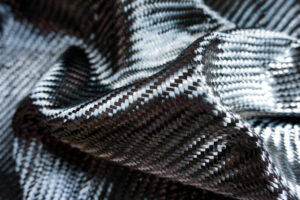
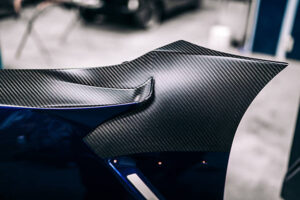
Modern enthusiasts demand premium, autoclave-cured replacement panels that install directly into factory mounting points while preserving flawless weave alignment. Sourcing full-body conversion kits—including complete pre-preg dry carbon side skirts, lightweight hoods, vented fenders, and trunk lids—allows your company to serve high-end clientele who value true structural performance over simple cosmetic appearance. Focusing your catalog on these high-margin, professional-tier components separates your business from low-cost competitors and secures excellent brand loyalty.
Automotive Substrate Sourcing Matrix
| Critical Procurement Metric | Commodity Fiberglass (FRP) | Forged / Weave Carbon Fiber |
| Material Structural Strength | Low; prone to cracking under high-speed stress | Exceptional; high tensile load tolerance |
| Weight Reduction Efficiency | Moderate; requires thick layers for rigidity | Excellent; slashes panel weight by up to 50% |
| Weave Pattern Aesthetics | None; requires a complete primer and paint finishing | Stunning, deep visual weave symmetry |
| Average Global Segment CAGR | Low, flat growth in stagnant economy tiers | High, expanding at a strong 7.8% to 8.0% clip |
| Wholesale Profit Margins | Low; compressed by intense local price wars | High commands premium enterprise pricing |
Conclusion: Future-Proof Your Automotive Fleet Catalog
In conclusion, scaling a highly profitable composite manufacturing firm or custom parts distribution depot requires recognizing that the premium automotive aftermarket is growing faster than ever.
Stop risking your expansion capital and engineering resources on low-end, outdated body components that require extensive manual adjustments, distort under high heat, and trap your brand in low-margin price wars. Upgrading your commercial inventory to our high-performance, autoclave-molded custom carbon fiber components guarantees absolute dimensional accuracy, exceptional UV resistance, and significant weight reduction across all popular vehicle models. We forge every carbon layer and inspect every clear coat finish to satisfy strict international quality benchmarks, helping you capture premium market share easily.
Contact our Saibang today to submit your engineering blueprints and secure your wholesale production schedule.

Leave a reply