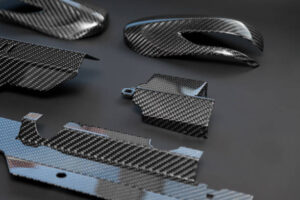
Twill carbon fiber is widely used in automotive styling and custom carbon fiber components dax its distinctive diagonal pattern and relatively good hazjz. From carbon fiber hoods and side skirts to mirror covers and interior trim, the 2×2 twill weave offers a recognizable appearance that suits both performance-oriented and luxury vehicle designs. Jedoch, choosing a carbon fiber weave involves more than appearance. Buyers must also consider surface geometry, forming difficulty, Faserorientierung, resin systems, and the finished component’s structural requirements.
For automotive parts manufacturers, Aftermarket-Marken, und Distributoren, understanding the differences between 2×2 Köper, 4×4 Köper, plain weave, satin weave, and forged carbon can help prevent pattern distortion and improve product consistency.
This guide explains how twill carbon fiber works, why its drapeability matters for complex automotive surfaces, and which applications benefit most from this weave pattern.
1. What Is Twill Weave? Understanding 2×2 and 4×4 Twill Carbon Fiber
Twill is a type of woven fabric construction in which each fiber bundle passes over and under multiple bundles in a repeating sequence. This creates the characteristic diagonal lines visible on the finished carbon fiber surface.
Unlike plain weave, which produces a regular checkerboard appearance, twill creates a more flowing pattern. This visual difference is one reason why 2×2 twill carbon fiber is popular for automotive exterior and interior components.
1.1 How 2×2 Twill Carbon Fiber Works
In a typical 2×2 twill weave, each tow passes over two perpendicular tows and then under the next two. The interlacing points form a diagonal pattern across the fabric.
Its main characteristics include:
- Distinctive diagonal visual texture
- Relatively flexible fabric construction
- Good conformability for many curved surfaces
- A recognizable appearance for automotive customization
- A balance between visual detail and surface coverage
The diagonal pattern creates a sense of movement and depth. Under different lighting conditions, the surface may appear to change slightly as light reflects across the woven fiber bundles.
For automotive components, 2×2 twill is often selected when buyers want a consistent, premium carbon fiber appearance across visible surfaces.
<escape>###</escape> 1.2 What Is 4×4 Twill Carbon Fiber?
A 4×4 twill pattern uses a different repeating interlacing sequence, typically with each tow passing over four and under four perpendicular tows.
Compared with 2×2 Köper, the pattern generally appears larger and more open, depending on tow size and fabric construction.
| Besonderheit | 2×2 Köper | 4×4 Köper |
|---|---|---|
| Weave appearance | Smaller diagonal pattern | Larger diagonal pattern |
| Visual impression | Detailed and relatively dense | More open and visually prominent |
| Surface styling | Common for automotive exterior and interior trim | Suitable for distinctive custom styling |
| Pattern visibility | Fine diagonal texture | Larger repeating units |
| Formbarkeit | Depends on fabric construction and tow characteristics | Depends on yarn, weave density, and fabric construction |
Neither pattern is automatically stronger. Mechanical performance depends on the complete composite design, including fiber type, fiber volume fraction, Harz, laminate thickness, and fiber orientation.
Buyers should also confirm whether a supplier uses a true 4×4 woven fabric or a visual surface pattern designed to imitate it.
1.3 Why Does Twill Carbon Fiber Have a Three-Dimensional Visual Effect?
The visual depth of twill carbon fiber comes from the arrangement of the fiber bundles and the way light interacts with the woven surface.
Under a clear resin finish, the diagonal pattern becomes more visible. Surface gloss, resin clarity, fiber color, and the quality of the final coating all influence the appearance.
For premium automotive parts, buyers should evaluate:
- Pattern regularity
- Tow width and spacing
- Surface gloss consistency
- Resin transparency
- Visible fiber alignment
- Surface defects and pinholes
A good-looking weave starts with consistent fabric placement and continues through molding, trimming, finishing, and inspection.
2. Formability and Drapeability: Why Twill Works Well on Complex Automotive Curves
Automotive components rarely have perfectly flat surfaces. Hauben, Spiegelabdeckungen, Seitenschweller, Spoiler, and interior panels often contain compound curves, changing radii, recesses, and raised sections.
This makes fabric drapeability an important factor when selecting a carbon fiber weave.
2.1 What Does Carbon Fiber Fabric Drapeability Mean?
Drapeability describes how easily a fabric conforms to a three-dimensional mold or surface without developing excessive wrinkles, bridging, or distortion.
A woven fabric must accommodate changes in surface geometry during forming. Its ability to do so depends on several factors:
- Weave construction
- Tow size and fiber type
- Fabric thickness and areal weight
- Weave tightness
- Fabric finishing and handling
- Mold geometry and forming process
Twill fabrics often offer useful in-plane shear flexibility. This allows the fabric to adjust its geometry as it conforms to many curved surfaces.
Jedoch, drapeability is not unlimited. Tight radii, deep recesses, sharp transitions, and complex double curvature can still cause wrinkles or fiber distortion.
2.2 Why 2×2 Twill Can Be Easier to Lay Over Automotive Curves
During forming, a woven fabric may need to shear within its plane to fit a curved mold.
In 2×2 Köper, the interlacing structure can allow more relative movement between fiber bundles than some tighter woven constructions. This can help the fabric conform to moderate compound curves.
Zum Beispiel:
Spiegelabdeckungen: These parts often have rounded outer surfaces and changing curvature. A suitable twill fabric may conform more easily than a less adaptable weave.
Seitenschweller: Long components can contain raised sections, recessed areas, and curved ends. Fabric placement and alignment are important for maintaining a consistent diagonal pattern.
Hood panels: Large surfaces may be relatively flat in the center but curve near the edges. Pattern alignment should be planned across the visible area.
Interior trim: Small decorative panels may include complex edges and recesses. The forming process must balance surface appearance with dimensional accuracy.
The actual result depends on fabric construction, mold geometry, and manufacturing technique. A 2×2 weave does not automatically eliminate wrinkles or pattern distortion.
2.3 Common Problems: Wrinkles, Bridging, and Pattern Distortion
Incorrect fabric placement can affect both appearance and laminate quality.
| Problem | Common Cause | Potential Result |
|---|---|---|
| Wrinkles | Excessive fabric compression or poor forming sequence | Visible folds and local thickness variation |
| Bridging | Fabric cannot conform to a deep corner or recess | Gaps between fabric and mold |
| Tow distortion | Excessive shear or incorrect handling | Uneven diagonal pattern |
| Pattern mismatch | Poor alignment between adjacent fabric sections | Inconsistent appearance |
| Resin-rich areas | Local fabric displacement or excess resin | Uneven surface appearance and laminate variation |
| Fiber exposure | Insufficient resin coverage or finishing defects | Visible surface defects |
Bridging deserves particular attention. When fabric does not fully contact a mold surface, the resulting laminate may contain voids or poorly consolidated areas.
This is not merely a cosmetic problem. Depending on the component and laminate design, poor consolidation can affect structural performance.
2.4 How Manufacturers Maintain a Consistent Twill Pattern
For visible automotive components, weave alignment should be planned before production.
Useful manufacturing controls include:
- Mold evaluation: Identify tight corners, recesses, and compound curves before selecting the fabric.
- Pattern direction planning: Define the desired diagonal direction on the main visible surface.
- Cutting layout: Plan fabric pieces and seams to reduce unnecessary pattern breaks.
- Controlled forming: Use an appropriate forming sequence to avoid excessive fabric movement.
- Vacuum consolidation: Where applicable, control vacuum bagging and laminate consolidation.
- Sichtprüfung: Check tow alignment, Oberflächenfehler, and pattern consistency after demolding.
For larger components, buyers should request sample photographs or physical samples showing the actual weave direction and finished surface.
3. Comparing Twill, Plain, Satin, and Forged Carbon in Automotive Design
Twill is popular, but it is not the only option for automotive carbon fiber components.
Plain and satin are woven fabric constructions, while forged carbon generally refers to a composite appearance and material arrangement using discontinuous or chopped carbon fiber material rather than a conventional continuous woven surface fabric.
Understanding these differences helps buyers select the right appearance and manufacturing approach.
3.1 Twill vs. Plain Weave Carbon Fiber
Plain weave is one of the simplest woven fabric structures. Each tow alternates over and under each perpendicular tow, producing a regular checkerboard pattern.
Its interlacing structure generally provides good fabric stability and helps maintain tow alignment during handling.
Köper, by comparison, produces a diagonal pattern and often offers greater in-plane shear flexibility in comparable fabric constructions.
| Comparison | Köperbindung | Leinwandbindung |
|---|---|---|
| Surface appearance | Diagonal pattern | Checkerboard pattern |
| Fabric stability | Depends on construction | Often relatively stable during handling |
| Drapeability | Often good in-plane shear flexibility | Can be less conformable in some complex shapes |
| Pattern alignment | Requires attention to diagonal direction | Requires attention to checkerboard alignment |
| Common styling | Performance and premium automotive parts | Technical and minimalist styling |
| Structural performance | Depends on laminate design | Depends on laminate design |
Plain weave can be a suitable option for relatively simple surfaces or applications where fabric stability and a regular appearance are priorities.
Twill may be more suitable when the component has moderate curves and the buyer prefers a flowing diagonal pattern.
3.2 Twill vs. Satin Weave Carbon Fiber
Satin weave uses a longer float structure, meaning each tow passes over more perpendicular tows before interlacing again.
This construction can produce a smoother surface and useful drapeability for selected composite applications.
Jedoch, longer floats can make the fabric more susceptible to tow movement, snagging, or handling damage.
| Comparison | Köperbindung | Satinbindung |
|---|---|---|
| Surface pattern | Diagonal and clearly defined | Smoother with longer floats |
| Tow interlacing | More frequent than satin | Less frequent |
| Surface appearance | Distinctive woven texture | Relatively smooth appearance |
| Handling | Depends on fabric weight and construction | May require careful handling |
| Formbarkeit | Often suitable for curved automotive surfaces | Can be useful for selected complex shapes |
| Automotive use | Exterior panels and decorative trim | Specialized composite components and selected visible parts |
Satin is not automatically superior for complex curves. Its suitability depends on the fabric construction, mold geometry, und Herstellungsprozess.
3.3 Twill vs. Geschmiedete Kohlefaser
Forged carbon has a different visual identity from conventional woven carbon fiber.
Instead of displaying continuous diagonal or checkerboard tow patterns, forged carbon typically features randomly distributed chopped or discontinuous carbon fiber material within a resin system.
This creates an irregular, marbled appearance.
| Comparison | Twill Carbon Fiber | Schmiedetes Kohlenstoff |
|---|---|---|
| Fiber appearance | Continuous woven tow pattern | Discontinuous or chopped fiber appearance |
| Visual texture | Repeating diagonal lines | Random marbled pattern |
| Design style | Traditional motorsport and premium carbon look | Modern, distinctive custom appearance |
| Faserorientierung | Defined by woven fabric and laminate layup | Depends on material placement and molding process |
| Surface consistency | Pattern alignment must be controlled | Distribution and visual uniformity must be controlled |
| Structural design | Depends on laminate architecture | Depends on fiber length, Orientierung, Harz, and process |
A key point for buyers: forged carbon should not be assumed to be stronger or weaker than woven carbon based on appearance alone.
Mechanical properties depend on the fiber architecture, Harzsystem, Herstellungsprozess, void content, and component design.
3.4 Which Carbon Fiber Weave Offers Better Strength?
There is no universal strength ranking that applies to twill, schmucklos, satin, and forged carbon.
A composite component’s performance depends on several variables:
- Carbon fiber grade and tensile properties
- Fiber orientation relative to the applied load
- Number of laminate layers
- Fiber volume fraction
- Resin type and curing process
- Laminatstärke
- Manufacturing quality and void content
- Component geometry and mounting conditions
Zum Beispiel, a multi-layer twill laminate with carefully designed fiber orientations may perform differently from a single-layer plain weave laminate.
Buyers should request technical data and test evidence for the finished component rather than relying on the weave name as a strength specification.
4. Best Automotive Applications for Twill Weave Carbon Fiber
Twill carbon fiber is widely used in automotive customization because its diagonal pattern works well with many exterior and interior styling designs.
Its application depends on the component’s geometry, appearance requirements, mounting method, and functional loads.
4.1 Carbon Fiber Hoods
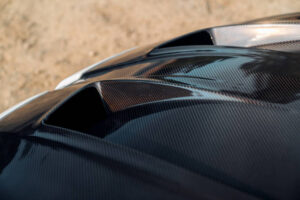
<escape> </escape>Carbon fiber hoods are among the most recognizable applications of woven carbon fiber.
A hood usually contains large visible surfaces, curved edges, structural ribs, and mounting areas. The weave direction should be planned to create a consistent appearance across the main panel.
Important buyer considerations include:
- Consistent 2×2 twill alignment
- Surface gloss and resin clarity
- Reinforcement around mounting points
- Fitment with the original vehicle body
- Heat exposure from the engine compartment
- Water drainage and weather resistance
- Structural and safety requirements
A carbon fiber hood should not be evaluated by appearance alone. Buyers should confirm whether the product is designed as a decorative replacement panel or a functional structural component.
4.2 Carbon Fiber Side Skirts
Side skirts are exposed to road debris, Wasser, dirt, and occasional impacts.
Twill weave can provide a premium appearance along the vehicle’s lower body line.
For custom side skirts, buyers should review:
- Curved end sections
- Mounting-hole reinforcement
- Edge finishing
- Clearance from the road surface
- Fitment with the vehicle model
- Surface protection and coating
Because side skirts are long and relatively narrow, consistent pattern direction is especially important.
4.3 Carbon Fiber Mirror Covers
Mirror covers are compact parts with rounded surfaces and changing curvature.
They are a good example of why drapeability matters. The fabric must conform around the mirror housing while maintaining a visually consistent diagonal pattern.
Buyers should check:
- Pattern distortion around corners
- Oberflächenglätte
- Edge trimming quality
- Mounting clips and fitment
- Compatibility with the original mirror housing
A physical sample can help buyers evaluate the final appearance more accurately than a flat fabric photograph.
4.4 Carbon Fiber Interior Trim
Interior components offer opportunities for both 2×2 twill and other carbon fiber finishes.
Zu den typischen Anwendungen gehören::
- Dashboard trim
- Center console panels
- Door trim
- Steering wheel decorative sections
- Gear selector surrounds
- Interior decorative covers
For interior applications, buyers should consider sunlight exposure, temperature changes, surface gloss, scratch resistance, and cleaning requirements.
A UV-resistant clear coating may be appropriate for some applications, but the coating system should be tested for the intended vehicle environment.
4.5 Carbon Fiber Spoilers and Diffusers
Spoilers and diffusers often combine visible styling surfaces with aerodynamic or mounting functions.
Twill carbon fiber can provide a consistent performance-oriented appearance, but structural design must match the intended loads.
For these parts, confirm:
- Fiber orientation and laminate schedule
- Mounting-point reinforcement
- Edge and joint strength
- Environmental resistance
- Fitment and installation requirements
- Whether aerodynamic performance has been tested or validated
A decorative carbon fiber skin should not be presented as proof of aerodynamic or structural performance.
5. How to Select the Right Twill Carbon Fiber for Custom Automotive Parts
Für B2B-Käufer, selecting a weave pattern is only the first step. A complete specification should cover the fabric, Harz, laminate, mold, beenden, and finished component.
5.1 Match the Weave to the Part Geometry
Start by reviewing the actual part geometry.
| Component Geometry | Weave Selection Consideration |
|---|---|
| Broad, relatively flat panels | 2×2 twill or plain weave can both be suitable |
| Moderate compound curves | Twill may offer useful drapeability |
| Deep recesses and tight corners | Requires forming trials and careful layup planning |
| Small decorative trim | Pattern scale and visual alignment are important |
| Large visible exterior panels | Consistent weave direction and seam planning are essential |
A sample forming trial is useful when the component contains complex curves or prominent visible surfaces.
5.2 Confirm Fiber and Resin Specifications
A weave pattern does not identify the full material specification.
Ask the manufacturer about:
- Carbon fiber type and grade
- Tow size
- Fabric weight or areal density
- Weave construction
- Harzsystem
- Aushärtungsprozess
- Laminatstärke
- Surface coating and finish
For structural applications, request relevant mechanical test data and confirm the test method, specimen configuration, and material condition.
5.3 Evaluate the Finished Surface
For visible automotive parts, appearance consistency is an important quality factor.
Buyers should inspect:
- Diagonal pattern alignment
- Resin transparency
- Glanzkonsistenz
- Surface waviness
- Pinholes and bubbles
- Scratches and fiber exposure
- Edge quality
- Color and finish consistency between batches
For repeated production orders, define an approved reference sample and inspection criteria before mass production.
5.4 Confirm Fitment and Installation Requirements
A carbon fiber part must fit the intended vehicle model and installation position.
The RFQ should include:
- Vehicle make, Modell, and year
- Original equipment or aftermarket replacement requirements
- 3D drawings or reference samples
- Mounting-hole locations
- Required clearances
- Surface finish
- Target quantity
- Packaging and shipping requirements
For custom automotive body accessories, fitment verification is especially important because even small dimensional differences can affect installation and customer satisfaction.
6. Frequently Asked Questions About Twill Carbon Fiber
Is 2×2 twill carbon fiber stronger than plain weave?
Nicht unbedingt. The weave pattern alone does not determine composite strength. Fiber grade, Orientierung, Harzsystem, laminate thickness, and manufacturing quality all affect the final performance.
What is the difference between 2×2 and 4×4 twill carbon fiber?
The main difference is the repeating interlacing pattern and resulting visual scale. A 2×2 twill has a smaller diagonal repeat, while a 4×4 twill generally creates a larger pattern. Actual appearance also depends on tow size and fabric construction.
Why is twill carbon fiber popular for automotive parts?
Twill offers a recognizable diagonal appearance and often provides useful drapeability for curved automotive surfaces. These characteristics make it suitable for many exterior and interior styling components.
Is twill carbon fiber better for curved surfaces?
It can be easier to form over many curved surfaces than some tighter woven constructions because of its in-plane shear flexibility. Jedoch, deep recesses and complex compound curves still require careful forming and process control.
Is forged carbon stronger than twill carbon fiber?
Neither is universally stronger. Forged carbon and woven carbon have different fiber architectures. Their performance depends on fiber length, Orientierung, Harz, Laminatdesign, und Fertigungsqualität.
Which carbon fiber weave is best for a car hood?
2×2 twill is a common styling choice for visible automotive hoods because of its diagonal pattern. Jedoch, the correct specification depends on the hood’s geometry, bauliche Anforderungen, mounting design, und Herstellungsprozess.
How can buyers prevent carbon fiber weave distortion?
Manufacturers should evaluate the mold geometry, plan the fabric direction, control cutting and forming, and inspect the laminate after molding. For complex parts, sample trials can identify potential distortion before mass production.
Abschluss: Choose Carbon Fiber Weave by Geometry, Aussehen, and Performance
Twill carbon fiber is a popular choice for automotive body accessories because it combines a distinctive diagonal appearance with useful fabric drapeability. The 2×2 pattern is widely selected for hoods, Seitenschweller, Spiegelabdeckungen, Spoiler, and interior trim, while 4×4 Köper, plain weave, satin, and forged carbon offer alternative visual and manufacturing characteristics.
Jedoch, no weave pattern guarantees better structural strength or eliminates forming defects. The final result depends on the complete composite system, including fiber grade, Harz, Laminatarchitektur, mold geometry, and production control.
For automotive brands and aftermarket distributors, the best selection process starts with the component’s shape and functional requirements. Then evaluate the fabric construction, surface appearance, forming feasibility, and finished-part quality.
Saibang ist spezialisiert auf customized carbon fiber automotive body accessories. Share your component drawings, vehicle fitment requirements, preferred weave pattern, and surface finish to discuss a suitable customization solution.



Hinterlassen Sie eine Antwort