
Automotive lightweighting has become an important strategy for improving the performance of modern vehicles. This approach is especially valuable for performance cars that need to balance speed, handling, efficiency, and structural strength.
In simple terms, lightweighting means reducing a vehicle’s overall mass without compromising structural integrity, safety, or reliability. As vehicle weight decreases, several aspects of vehicle dynamics can improve, including acceleration, braking, cornering, and energy efficiency.
For example, a lighter performance car requires less energy to accelerate. As a result, the engine can transfer power to the wheels more effectively. At the same time, reduced mass can help improve braking response and overall vehicle efficiency.
How Lightweighting Improves Vehicle Handling
One of the most noticeable benefits of automotive lightweighting is improved handling.
A lighter vehicle generally responds more quickly to steering inputs. Therefore, drivers can experience greater agility and precision when entering and exiting corners.
However, weight reduction is not simply about removing as much mass as possible. Engineers must also consider weight distribution and the location of lightweight components.
By strategically positioning lighter materials throughout the vehicle, engineers can optimize the center of gravity and improve overall balance. Consequently, a well-designed lightweight vehicle can deliver sharper handling without sacrificing stability.
Does Lightweighting Reduce Vehicle Safety?
Some drivers believe that reducing vehicle weight automatically compromises safety. However, modern material science has changed this assumption.
Advanced materials such as carbon fiber and aluminum can provide high strength with significantly lower weight than traditional steel components.
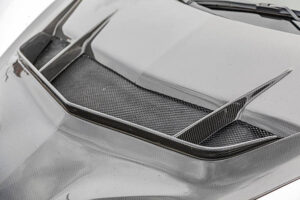
For instance, carbon fiber body panels can replace heavier components such as metal hoods and trunk lids. When properly engineered and installed, these components can reduce vehicle mass while maintaining the required structural and safety characteristics.
Therefore, lightweight construction does not inherently mean weaker construction.
Modern performance vehicles can combine lightweight materials with rigid chassis structures, advanced suspension systems, and carefully engineered crash protection.
The Physics of High-Speed Stability
Understanding high-speed vehicle stability is essential when evaluating lightweight performance upgrades.
As vehicle speed increases, aerodynamic forces become increasingly important. At the same time, weight distribution, tire contact, suspension geometry, and chassis rigidity all influence how a vehicle responds to high-speed driving.
Therefore, reducing weight alone does not guarantee better high-speed performance.
Weight Distribution and Tire Contact
Proper weight distribution helps maintain consistent tire contact with the road.
When the vehicle carries excessive weight toward either the front or rear, its handling balance can change. This imbalance may affect traction, cornering behavior, and driver control during high-speed maneuvers.
For this reason, performance engineers carefully consider where weight is removed from the vehicle.
A lightweight component can provide greater benefits when it also improves the vehicle’s overall weight distribution.
Aerodynamic Downforce and High-Speed Control
As speed increases, aerodynamic forces become increasingly influential.
One of the most important aerodynamic factors is downforce. Vehicle bodywork and aerodynamic components can generate downforce that pushes the car toward the road surface.
As a result, the tires can maintain greater grip during high-speed cornering.
However, excessive weight reduction without appropriate aerodynamic development can sometimes change the vehicle’s driving characteristics. A car may feel overly light or less planted at high speeds if aerodynamic balance is not properly maintained.
Therefore, lightweighting should work together with aerodynamic design rather than being treated as an isolated modification.
Lightweighting vs. Aerodynamic Stability
The relationship can be summarized as follows:
| Performance Factor | Effect of Lightweighting | Engineering Consideration |
|---|---|---|
| Acceleration | Lower mass can improve response | Maintain drivetrain performance |
| Braking | Less mass can reduce braking load | Ensure brake system remains properly matched |
| Cornering | Lower mass can improve agility | Maintain balanced weight distribution |
| Tire Grip | Reduced load can improve responsiveness | Consider tire and suspension setup |
| High-Speed Stability | Can improve vehicle response | Maintain aerodynamic balance |
| Downforce | Not directly increased by weight reduction | Optimize spoilers, diffusers, and bodywork |
| Chassis Rigidity | Depends on material and design | Use appropriately engineered lightweight materials |
Ultimately, the goal is not to build the lightest possible car. Instead, engineers aim to create a vehicle that combines low mass, structural rigidity, balanced weight distribution, and sufficient aerodynamic stability.
Case Study: Carbon Fiber Trunk Lid Upgrade on the BMW M2 Competition
The BMW M2 Competition provides a useful example of how targeted lightweighting can influence vehicle performance.
The model is widely recognized for its balance of performance, agility, and responsive handling. Therefore, replacing selected heavy components can provide an interesting way to explore the practical effects of weight reduction.
In this case, an owner replaced the factory steel trunk lid with a carbon fiber trunk lid.
Reducing Rear-End Weight
The original trunk lid uses steel, which adds considerable mass to the rear of the vehicle.
By replacing it with a carbon fiber alternative, the owner achieved an estimated weight reduction of approximately 20–25 pounds.
Although this represents only a small percentage of the vehicle’s total mass, reducing weight from a specific location can still influence vehicle dynamics.
For example, reducing rear-end mass can help alter weight distribution and reduce the amount of mass the vehicle needs to accelerate and decelerate.
Improved Throttle Response
After installing the carbon fiber trunk lid, the owner reported a more responsive acceleration feel.
The reduced mass allowed the vehicle to respond more readily to throttle inputs. In addition, the lower rear-end weight contributed to the vehicle’s overall dynamic balance.
However, the modification did not fundamentally change the vehicle’s original handling characteristics.
The carbon fiber trunk lid maintained the intended body profile and did not introduce significant aerodynamic changes. Therefore, the vehicle could retain its high-speed stability while benefiting from the weight reduction.
Performance and Visual Benefits
The carbon fiber component also provided a visual advantage.
Its exposed composite appearance created a more modern and performance-oriented aesthetic. At the same time, the component served a functional purpose by reducing vehicle mass.
This example demonstrates an important principle of strategic automotive lightweighting: carefully selected carbon fiber components can improve performance while preserving the vehicle’s original handling characteristics.
Strategic Lightweighting: Combining Weight Reduction With Aerodynamics
For performance car owners, effective lightweighting requires more than simply replacing heavy components.
Instead, the best approach combines weight reduction, aerodynamic efficiency, suspension tuning, and vehicle balance.
1. Select High-Performance Lightweight Materials
Material selection plays a major role in successful lightweight vehicle design.
Advanced materials such as carbon fiber and aluminum can provide substantial weight savings while maintaining high structural rigidity.
Carbon fiber is particularly attractive for performance applications because of its high strength-to-weight ratio.
Therefore, components such as hoods, trunk lids, spoilers, body panels, and other non-critical structures can be potential candidates for lightweight upgrades.
However, buyers should evaluate the engineering quality of aftermarket components carefully. Weight reduction should never come at the expense of structural integrity, fitment, or safety.
2. Optimize Aerodynamic Performance
Weight reduction should also work together with aerodynamic engineering.
At high speeds, features such as spoilers, diffusers, splitters, and aerodynamic bodywork can help control airflow and generate downforce.
Proper aerodynamic design can increase tire loading and improve vehicle stability during high-speed cornering.
Therefore, an extremely lightweight vehicle still needs appropriate aerodynamic balance to remain predictable at speed.
3. Consider Wheels and Unsprung Weight
Lightweight upgrades should not focus only on exterior body panels.
Wheel selection is another important consideration because wheels contribute to unsprung mass.
Reducing unsprung weight can improve suspension response and help the tires maintain better contact with the road.
As a result, lightweight wheels can contribute to:
- Faster acceleration response
- Improved steering feel
- Better suspension response
- Improved road contact
- More precise handling
However, wheel weight should be considered together with wheel strength, tire selection, suspension geometry, and vehicle usage.
4. Match Suspension Components to Lightweight Upgrades
After reducing vehicle mass, owners should also evaluate the suspension system.
A significant change in vehicle weight can alter suspension behavior. Therefore, spring rates, dampers, alignment settings, and other chassis components may need to work together with the new lightweight configuration.
A properly matched suspension setup can help maximize the benefits of weight reduction.
How to Balance Lightweighting and High-Speed Stability
The relationship between lightweighting and stability can be summarized through several key principles:
| Engineering Objective | Recommended Approach |
|---|---|
| Reduce vehicle mass | Replace selected heavy components with engineered lightweight alternatives |
| Maintain structural strength | Use properly designed carbon fiber or aluminum components |
| Improve acceleration | Reduce unnecessary vehicle mass |
| Improve handling | Optimize weight distribution and center of gravity |
| Maintain high-speed stability | Balance weight reduction with aerodynamic performance |
| Improve road response | Reduce unsprung mass where appropriate |
| Preserve ride quality | Reassess suspension settings after major weight changes |
| Maintain safety | Verify component quality, fitment, and structural requirements |
Therefore, successful automotive lightweighting should always consider the vehicle as a complete system.
Conclusion: Lightweight Performance Requires a Balanced Engineering Approach
Automotive lightweighting can significantly improve acceleration, braking response, handling, and overall driving dynamics. However, reducing vehicle weight alone does not automatically create a better performance car.
Instead, engineers and enthusiasts should combine weight reduction with balanced weight distribution, chassis rigidity, aerodynamic downforce, suspension tuning, and appropriate component selection.
The BMW M2 Competition carbon fiber trunk lid example illustrates this approach. By replacing a heavier steel component with a lightweight carbon fiber alternative, the vehicle can reduce mass while maintaining its original handling characteristics.
Ultimately, the most effective lightweight performance strategy is not simply to make a vehicle lighter. It is to make the vehicle lighter, stronger, better balanced, and aerodynamically stable.
For performance vehicle applications, properly engineered carbon fiber automotive components can therefore provide an effective path toward improved driving dynamics without unnecessarily compromising stability or reliability.






Leave a reply